"My work as a luthier centers on building a personal model and (re)creating iconic historical classical guitar models."
Concert Model
A sound rooted in Spanish tradition, enhanced
by modern expressive capabilities.
It is a powerful, dynamic guitar with a deep timbre
and a rich, expansive tone suited to any repertoire.
It features a refined, understated aesthetic inherited from the French school of lutherie (Dominique Field, Daniel Friederich, Robert Bouchet).

Guitars after Robert Bouchet (1898-1986)
Copies of the guitars of the French luthier Robert Bouchet. Painter and luthier, his aesthetic guitars have become legendary for their sound quality and their use by great artists. (the Presti-Lagoya duo, Julian Bream, the Pomponio-Zarate duo). The shape of the head as well as the design of the rosettes and the threading associated with a harmonious overall design laid the groundwork for French guitar making in a sober and elegant style. From 1956 he employed a bracing style with a large crossbar which he called "barre d'âme" The result is a very characteristic, long, precious and meaty sound.

Guitar after Daniel Friederich (1932-2020)
I was interested in the construction of a particular model that the famous Parisian luthier made at the beginning of his career. This is the "Arpège" model, the simplest in the catalog of 4 instruments that he offered for sale in the 60s. At the time, he was greatly inspired by the Torres bracing, as was his colleague Robert Bouchet before 1958. It is basically a "super-Torres" with a thin spruce top and rosewood sides and back. I particularly like the resulting sound: a robust, powerful Spanish sound, with fleshy and shimmering highs.

Guitars after A.de Torres
I make instruments that are faithfully close to Torres' guitars: They are light and reactive guitars with a warm timbre. Like Antonio de Torres, I build instruments with five different sizes, from the small kid-friendly guitar to the large guitar with modern proportions. The top is invariably made of spruce but for the back and sides, I use various woods (cypress, fruit tree, rosewood, etc.). I also offer heads with pegs instead of the usual mechanics.

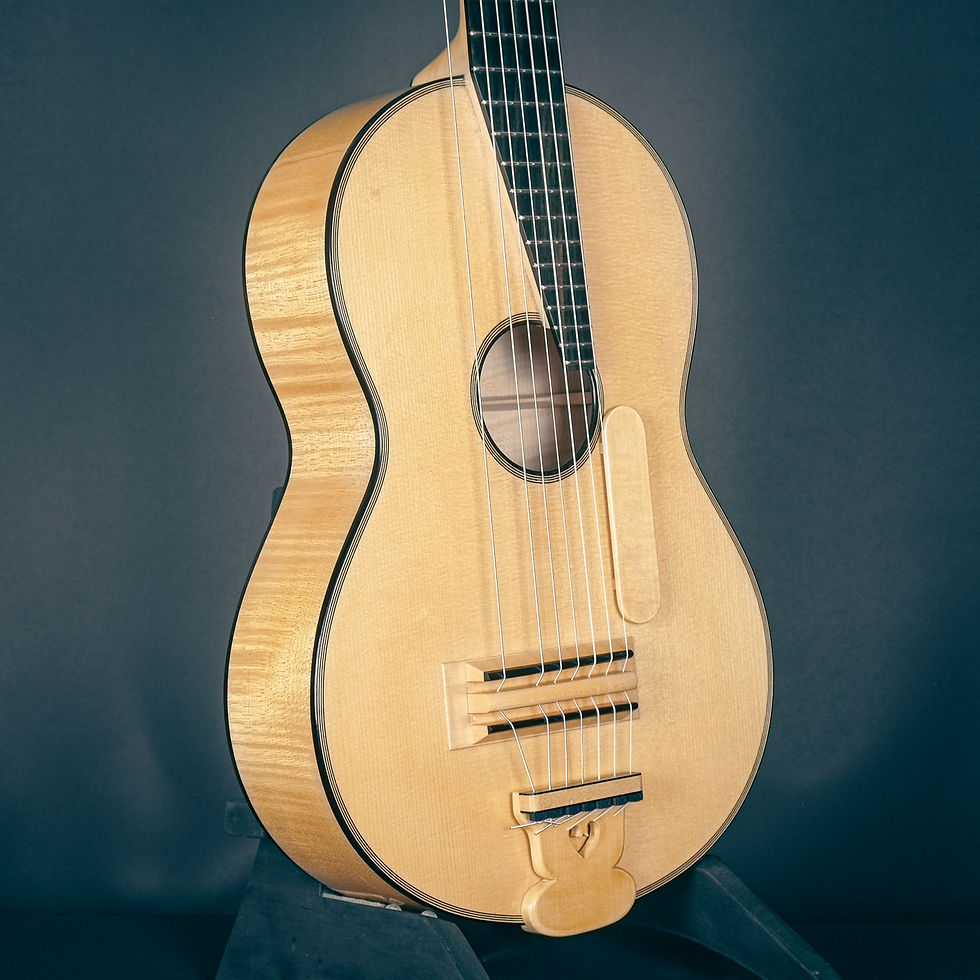
Guitar based on René Lacote (1785–1871)
A Romantic-era guitar that bears witness to the collaboration between the renowned Parisian luthier René Lacote and the virtuoso Napoléon Coste (1805–1883).
Early on, Coste desired a seventh string to allow for greater versatility, as well as a larger body volume. Added to this is the influence of Viennese guitars—such as those by Stauffer—featuring a raised fingerboard, 24 frets, and an innovative tailpiece system invented by Coste (the "Coste system").
The result is a Romantic guitar—a true concert instrument—tailored to the composer's virtuoso repertoire.